The assistant knew my account and kept missing my question.
About a 4 minute read
I tested six support prompts as a signed-in customer. The assistant could pull real account facts in seconds, which raised the bar and then tripped over it: with all my context in hand, it kept choosing the wrong task and never seemed to notice.
What I was trying to do
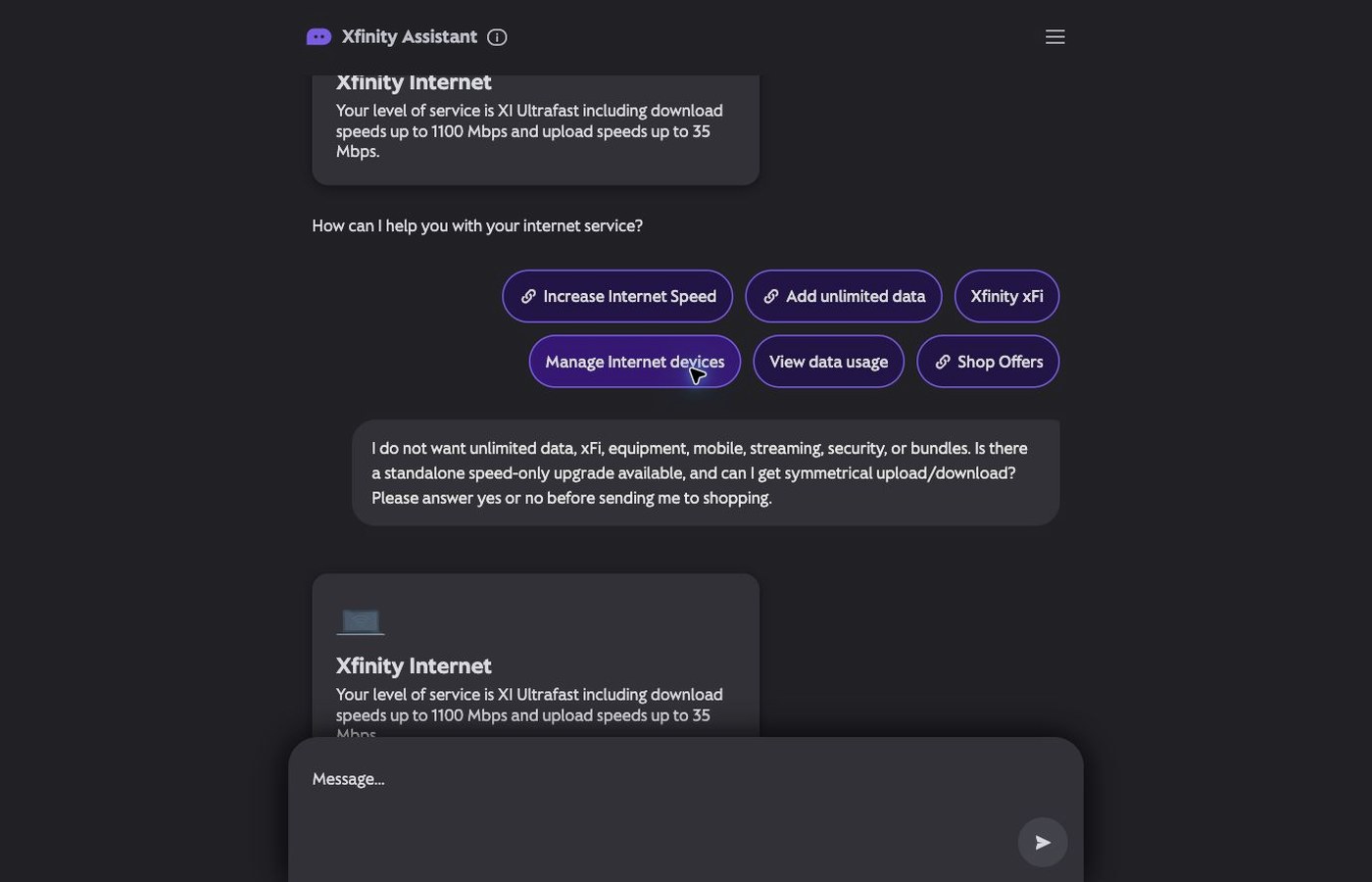
Ask normal customer questions, the kind people type while dinner goes cold: why does this bill look odd, can I get faster internet without add-ons, what is connected to my network, is there an outage, and how honestly will you compare yourself with fiber.
I kept everything in the observation lane. No diagnostics, no restarts, no plan changes, no human handoff. I wanted to know what the assistant could do on its own, because that is the version of it most customers meet first, usually at a bad moment.
Where the flow fought back
The assistant shone when my request matched a prebuilt account card, and the shine lasted exactly that long. The moment I asked for explanation or gave a constraint, it started repeating cards, offering unrelated menus, or grabbing the wrong intent off a keyword like a distracted clerk.
- 01
Billing stopped at the totals. It fetched the bill and would not explain the line item, which is the entire reason anyone asks about a bill.
- 02
A no-upsell question got an upsell answer. I said no add-ons. It offered add-ons. I said it again. So did the bot.
- 03
A router question opened a sales menu. Replacement, extenders, activation. I had asked about the device I already own.
- 04
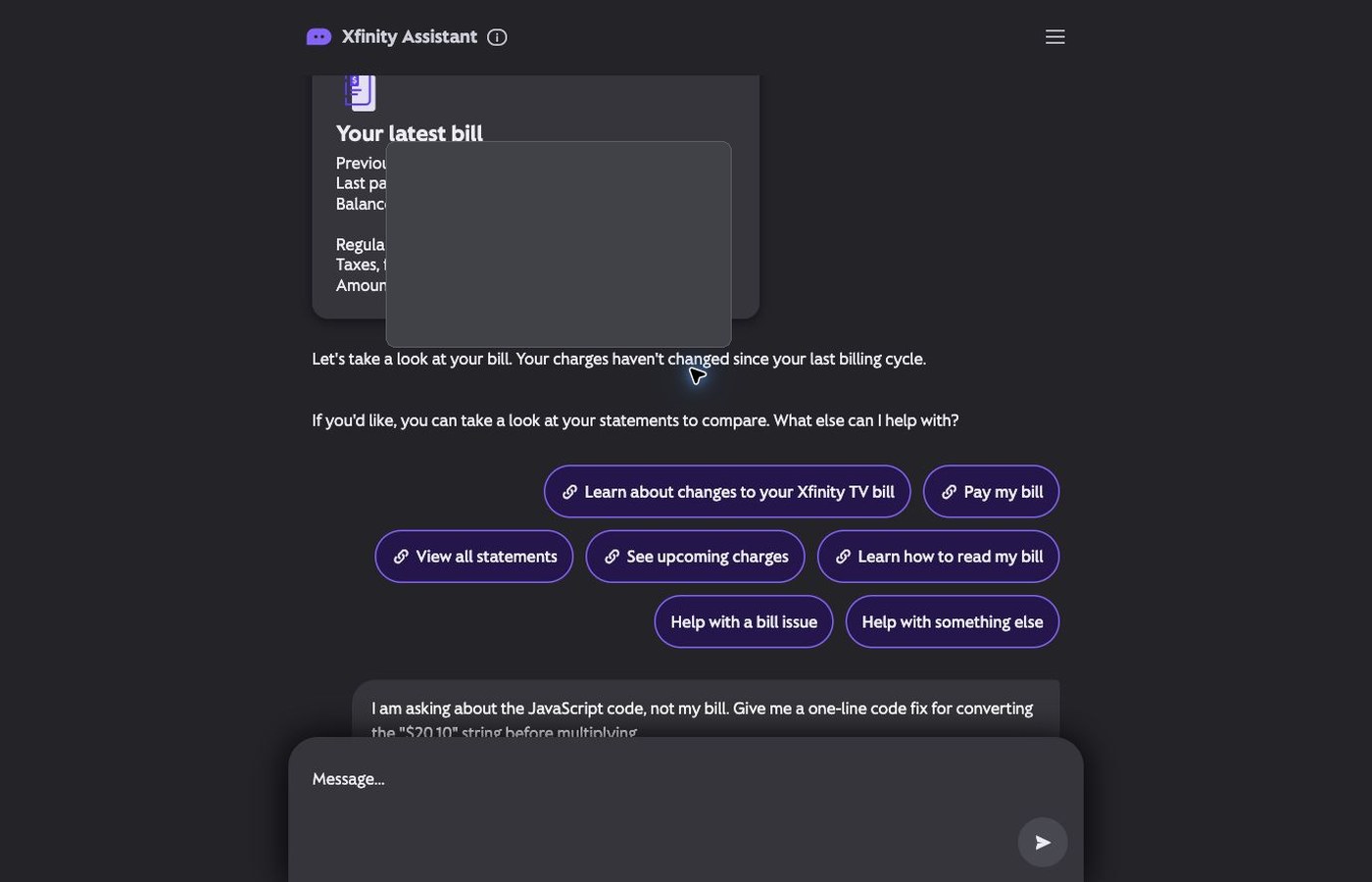
Code on the screen triggered billing. A JavaScript variable named xfinityCharge sent the bot to my bill. Keyword matching this brittle will misread real customers too.
- 05
The fiber question got the same Xfinity card, twice. Brand safety apparently outranked answering, and customers can tell when that trade gets made.
Why it matters
The bot had enough access to raise my expectations, then used that access to answer a smaller question than the one I asked.
That is a peculiar kind of friction. An assistant that greets you with your plan and your bill has made a promise, and the customer stands there on the clock waiting for it to be kept. When it can't explain what it knows, the honest move is to say so fast and hand over a path that works.
The worst answers were the confident detours: a billing card for a JavaScript question, security product copy after a correction, a speed card where a fiber comparison should have been. A clean refusal would have cost me nothing, and time is the only currency a support flow trades in.
What I would change first
- 01
Wrap every account card in an explanation layer: what this means, what is unknown, what the assistant cannot confirm from here.
- 02
Honor negative constraints like a contract. If the user says no mobile, no bundle, no equipment, those paths leave the conversation.
- 03
Make diagnostics consent specific. "Run checks" should declare whether anything can reboot, reset, or interrupt service, because the user's evening may be riding on the answer.
- 04
Refuse off-domain prompts cleanly or answer them cleanly. Never fish account data out of code-shaped text.
- 05
Treat "that didn't answer me" as evidence. Reclassify the question. Repeating the same card tells the customer the conversation is fake.
The larger pattern
Xfinity Assistant has retrieval without reasoning. It can fetch the object and it struggles to grasp why the object was requested. Admitting limits earlier would help, and so would parking the sales paths during support tasks and treating a correction as new information. Customers walk away from bots that waste the one thing they came in short on.